
Most portfolios are built on two pillars: stocks for growth and bonds for stability. That recipe worked for decades, but the 2022 market environment, when both stocks and bonds fell together, reminded investors that the diversification benefit they assumed was permanent is anything but. When equities and fixed income move in the same direction at the same time, the traditional 60/40 portfolio behaves like a single concentrated bet.
That is the structural problem life settlements were built to solve. They are one of the few asset classes where returns depend on mortality, a biological reality that is genuinely uncorrelated to interest rate decisions, earnings reports, and macroeconomic cycles. For an investor looking to diversify beyond the public markets, that property alone is worth understanding.
The non-correlation argument, more carefully
When market commentators describe an asset as "non-correlated," they usually mean it has a low historical correlation coefficient with the S&P 500. That is useful but incomplete. The deeper question is: what fundamentally drives this asset’s return, and is that driver linked to the same forces that move public markets?
A life settlement’s return is driven by two inputs: the size of the death benefit (fixed at the policy’s inception and contractually guaranteed by a regulated insurer) and the duration until that benefit is paid (governed by the insured’s actual lifespan). Neither of those inputs cares about the Fed, the yield curve, or quarterly earnings. That is structural non-correlation, not just statistical non-correlation. It tends to hold up in stress scenarios precisely when investors need it most.
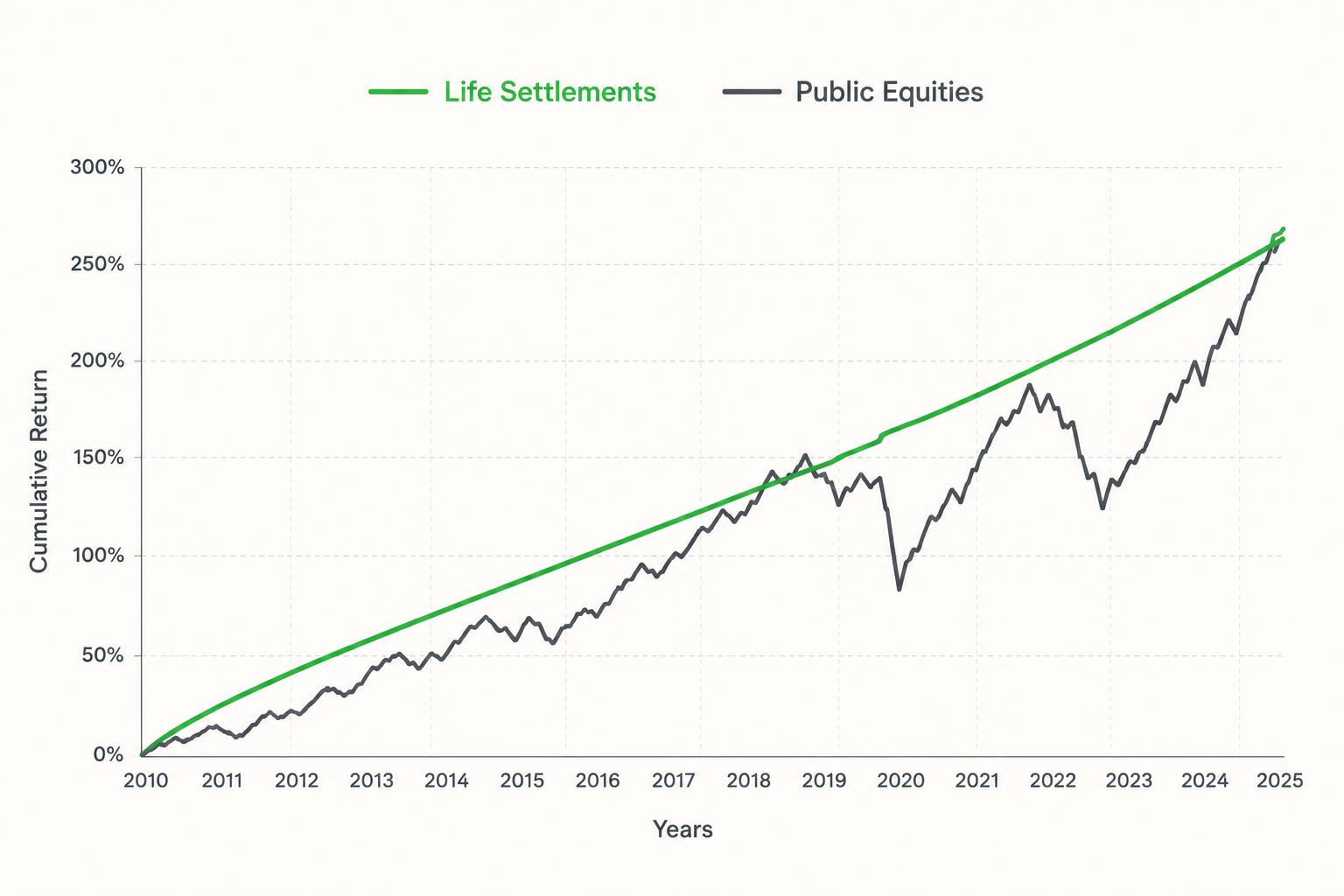
Returns backed by a regulated insurance carrier
The death benefit at the end of a life settlement is not paid by a startup, a private borrower, or a counterparty whose creditworthiness fluctuates. It is paid by a U.S. life insurance carrier, the same kind of institution that backs the policies your own family probably owns. These carriers are subject to state-level reserve requirements, capital regulations, and rating agency scrutiny. Defaults are exceptionally rare.
That counterparty quality is part of what gives life settlements their unusual return profile: equity-like upside in many cases, but underwritten by an investment-grade payer. Few asset classes can claim a similar structure.
Cash flows you can actually model
Unlike a stock, where future cash flows are forecasted from earnings models that bake in dozens of assumptions, a life settlement’s cash flows are contractually defined. The investor knows exactly what they will pay (the purchase price plus a schedule of future premiums) and exactly what they will receive (the death benefit). The only meaningful uncertainty is the timing of the payout.
“Contractual cash flows, mortality-driven timing, and an investment-grade payer. That combination is rare in modern markets.”
Sophisticated investors and funds manage timing risk through portfolio construction. By holding many policies across a diversified pool of insureds (different ages, genders, geographies, and health profiles), the actual mortality experience of the portfolio tends to converge on the actuarial expectation. The law of large numbers does the work that no single policy can do on its own.
The institutional shift, and why it matters
For most of the last twenty years, life settlements have been the domain of large institutional buyers like pension funds, endowments, sovereign wealth funds, and hedge funds. The reason was practical: minimum capital commitments often ran into the tens of millions, and operational complexity was high. Individual investors simply could not access the market.
That has changed. Modern technology, lower minimums, and more transparent platforms have opened the asset class to accredited individual investors. The institutions did not change their allocation because life settlements became trendy. They have been quietly allocating capital here for two decades because the returns earn the allocation. What is new is that individuals can now stand on the same side of the trade.

Risks you should weigh
No asset class is risk-free, and a balanced case requires acknowledging where life settlements can disappoint. Longevity risk is the headline concern: if insureds in a portfolio live materially longer than estimated, the time-weighted return falls because additional premium payments compress the spread between cost and payout. Disciplined underwriting and diversification across many lives are the primary defenses.
Liquidity is the second consideration. Life settlements are not publicly traded, and most positions are held to maturity. Investors should size their allocation accordingly. It is a long-duration, illiquid sleeve, not a tactical position. Premium-servicing risk (failing to keep policies in force) is real but operationally manageable, and reputable platforms handle this institutionally.
Where it fits in a portfolio
For most investors, life settlements are best understood as a diversifier inside an alternatives allocation, sitting alongside private credit, real estate, and infrastructure. A typical institutional allocation runs in the low-single-digit percentage of total portfolio assets, scaling up for investors with longer time horizons and tolerance for illiquidity. The point is not to replace stocks or bonds. It is to add a return stream whose drivers are different from everything else you own.
If you have built your wealth in public markets and you are looking for the next layer of diversification, life settlements deserve a serious look. The asset class has the structural properties that institutional allocators have been quietly compounding into for years.